Skisma
An abstract game of encirclement for two players, on a hexagonal or square board. Be the first to surround an enemy stone.
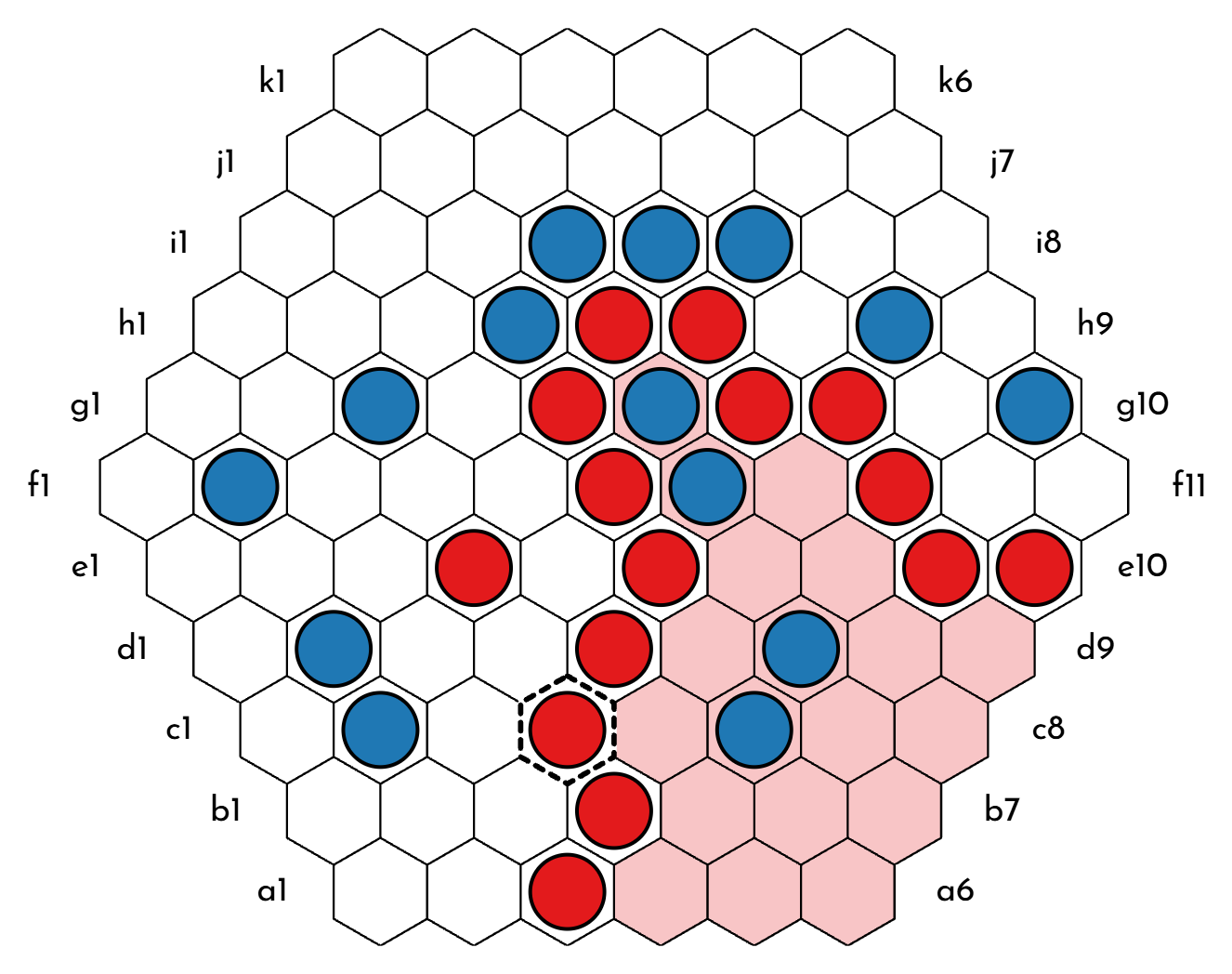
2 players · stones in two colours · a hexagonal board of hexagons, or a square board.
Goal: be the first to surround an enemy stone.
Definitions
- Edge cell: a cell on the border of the board.
- Group: a set of same-coloured stones connected through adjacent cells.
- A stone is surrounded when, because of a single enemy group, it can reach fewer than half of the edge cells. Paths go through any cell except that group’s stones.
Play
Players take turns placing one of their stones on an empty cell.
You may not place a stone where it would be surrounded, unless that move wins.
End
You win as soon as you surround an enemy stone.
If you have no legal move, you lose. This includes a full board: whoever fills the last cell wins. There are no draws.
Square board
Stones connect into groups through sides and corners, but paths only pass through sides. So a diagonal line of stones is a wall.
Examples
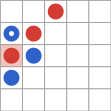
Red stones, blue stones, and the last move of each side are marked in the diagrams. Boards are small, for illustration.
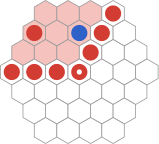
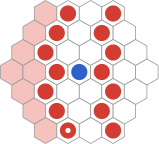
1. Against the edge. Only the group of Red’s last move counts: paths go through all other stones. The blue stone reaches 5 of the 18 edge cells (one holds a lone red stone): it is surrounded. Red wins.
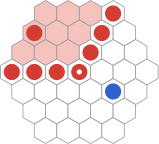
2. The larger part. Same wall, blue stone on the other side: it reaches 11 of the 18 edge cells. Not surrounded. Blue may not play in the top-left part (Red may).
3. Enclosure. The blue stone reaches no edge cell. Red wins.
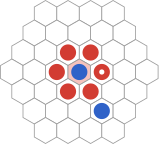
4. Halving the board. Each blue stone reaches 8 of the 18 edge cells: both are surrounded. Red wins.
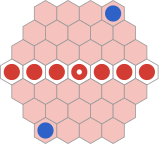
5. One group at a time. Red’s two walls are separate groups. Because of the left one, the blue stone reaches 9 of the 18 edge cells; because of the right one, it reaches 11. Walls do not add up: not surrounded.
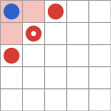
6. Square board: a diagonal wall. The blue stone reaches 3 of the 16 edge cells. Red wins.
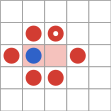
7. Square board: an eye. Red’s group is connected through corners. The blue stone reaches no edge cell. Red wins.
8. Square board: suicide that wins. Blue’s last move surrounds the red stone and therefore wins, despite being surrounded itself.
Copyright © 2026 Noé Falzon, under CC BY-NC 4.0.